Tuesday, January 31, 2023

Puzzlerium Tour: Leeway


Rules: Shade some cells such that each region outlined in bold contains as many shaded cells as small given numbers (if any) in top-left corner of the cell indicate.

- Shaded cells form blocks of orthogonally connected cells. Each such block is comprised of two or more distinct smaller blocks that are each wholly contained in a different region, thus separated by grid borders. For each block, there can only be one sub-block per region.

- Shaded cell blocks can only touch diagonally.

- Each given big number belongs to a block, giving its size, and each block contains exactly one given number. 

- All unshaded cells must be connected in a single group of orthogonally connected cells.  

- Any given black cells indicate the corresponding cell cannot be shaded. 


About: This puzzle was invented by Anurag Sahay.

Monday, January 30, 2023

Puzzlerium Tour: Chained Block


Rules: Shade some cells in the grid to form blocks of any shape.

1. Each block must contain exactly one number or a question mark.

2. A number indicates the size of the block that contains it.

3. Diagonally adjacent blocks form a chain. A chain cannot contain two identically shaped blocks, counting rotations and reflections as the same.

4. All blocks must be diagonally adjacent to at least one other block.

Saturday, January 28, 2023

Puzzlerium Tour: Touching pentominoes/tetrominoes (2-class)


Rules: Place some pentominoes and/or tetrominoes in the given grid without repetition. Figures may be rotated and reflected but may only touch each other diagonally. All the points of diagonal contact are given as black/white circles. Figures fall in two categories - one that touch circles of a single color, and one that touch circles of both colors. All pentominoes belong in one of the two categories, and all tetrominoes are in the other. 

Friday, January 27, 2023

Puzzlerium Tour: Emulsion


Rules: Shade some cells such that each outlined region contains two or more groups of orthogonally connected shaded cells of the same size but different shapes. There cannot be any other shaded cells. Shaded cell groups across regions can only touch diagonally, while they must all be connected to each other diagonally within a region. Given numbers indicate shaded cells part of a group of that size. Groups can not contain more than one given number. 

About: This puzzle was invented by Anurag Sahay.

Tuesday, January 24, 2023

Puzzlerium Tour: Mileage


Rules: Trace a loop that does not intersect itself and has horizontal and vertical paths between centers of cells, and visits each outlined region once. When two cells along the path both have the loop turning in them and are in different regions, they cannot be adjacent. Given numbers tell how many cells the loop does NOT visit in that region.

About: Invented by Anurag Sahay.


Monday, January 23, 2023

Puzzlerium Tour: Emulsion


Rules: Shade some cells such that each outlined region contains two or more groups of orthogonally connected shaded cells of the same size but different shapes. There cannot be any other shaded cells. Shaded cell groups across regions can only touch diagonally, while they must all be connected to each other diagonally within a region. Given numbers indicate shaded cells part of a group of that size. Groups can not contain more than one given number. 

About: This puzzle was invented by Anurag Sahay.

Sunday, January 22, 2023

Puzzlerium Tour: Castle Wall


Rules: Draw lines through orthogonally adjacent cells to form a loop.

1. Lines cannot go through bold borders.

2. White cells must be inside the loop, and black cells must be outside the loop. Grey cells are either black or white.

3. A number with an arrow indicates the number of line segments in that direction. Vertical arrows only count vertical lines, and horizontal arrows count horizontal lines.

Friday, January 20, 2023

Puzzlerium Tour: Yajilin


Rules: Shade some cells and draw a single closed loop through all remaining white cells, the loop's path moving horizontally  or vertically through cell centers. Clue cells may not be shaded. The loop may not intersect itself,  or go through a cell more than once. Shaded cells cannot share an edge with each other. Some cells contain a number and arrow, or a question mark, and may not be part of the loop. Numbered arrows in such cells indicate
the total number of shaded cells in the direction of the arrow.

Thursday, January 19, 2023

Puzzlerium Tour: Rassi Silai (Knotty)


Rules: Thread a rope in each region. A rope is a path that passes through all cells of the region, between two cells that are end-points. End-points do not touch each other, even diagonally, even across regions. Each path crosses itself once, and both segments go straight through the cell they intersect in. 

Wednesday, January 18, 2023

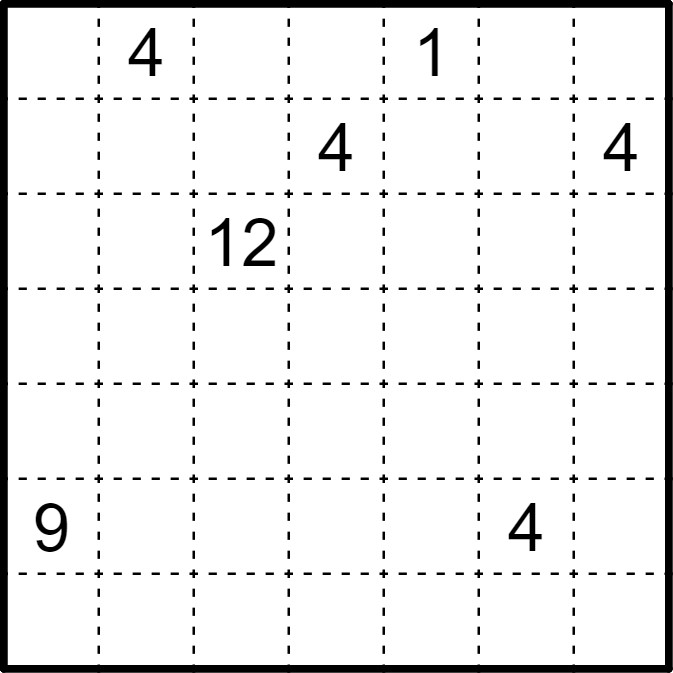
Puzzlerium Tour: Containers


Edit:  '1' was placed one cell off in the original version leaving the puzzle unsolvable 

Rules: Subdivide the grid along the borders into non-overlapping rectangular (but, not squares) regions, with each rectangle enclosing none, one, or more given numbers. No two rectangles of the same area can share an edge with each other. 

- Each rectangular region contains a square whose side is equal to the shorter side of the containing rectangle, and which can be positioned in a unique slot somewhere along the length of the rectangle. Squares may be as small as 1x1.

- Squares do not touch each other, except at a point.

- Given numbers either represent the area of a rectangle or a square occupying that cell. 

- All cells not belonging to squares form a single group of orthogonally connected cells.  

About : This puzzle type was invented by Anurag Sahay.